IFF
Ambroxan (Ambermor® by IFF) | Perfumery Raw Material
Ambroxan (Ambermor® by IFF) | Perfumery Raw Material
Couldn't load pickup availability
Ambermor® by IFF – Ambroxan
Ambroxan raw material by IFF for professional perfumery
Ambermor® is IFF's trade name for Ambroxan (CAS 6790-58-5).
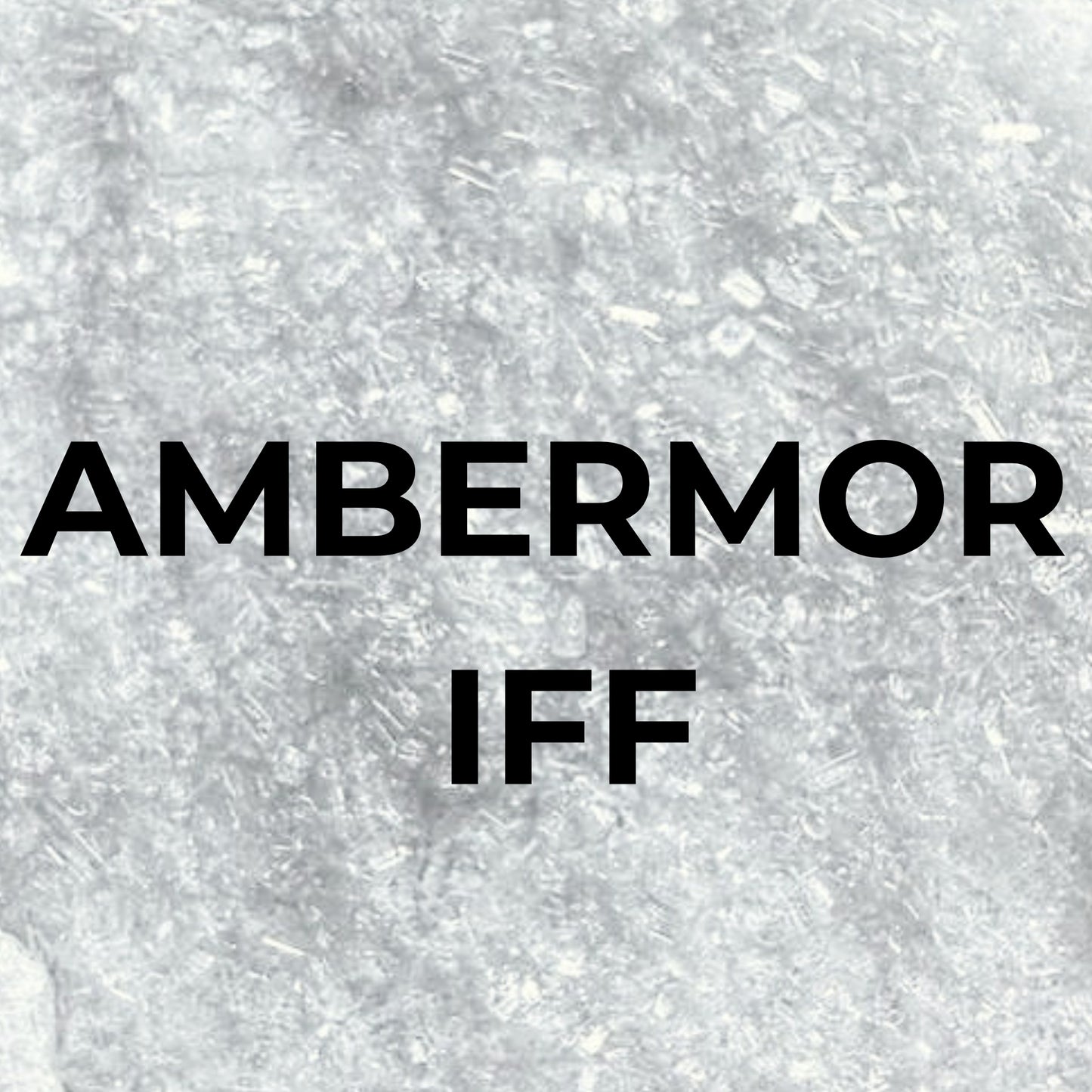
White crystals. Synthetically produced. One of the most widely used raw materials in professional perfumery – from niche fragrances to commercial compositions.
Ambroxan reshapes a formula not through its own scent, but through its effect: more depth, more projection, a radiance that lingers on the skin.
Odor profile of Ambroxan
Ambroxan is perceived as:
- dry woody amber
- warm mineral facets
- a light sweetness in the heart
- transparent woody-amber depth
- subtle skin warmth
- a long-lasting drydown
The scent reads dry, warm and clearly contoured. Ambroxan is rarely perceived as a single note – rather as an added dimension within a formula.
What is Ambroxan used for in perfumery?
- amber and woody-amber accords
- tenacity and substantivity
- diffusion and projection
- a woody-ambered base
- woody, amber and musk compositions
- drydown and depth
- a skin-close amber effect
As a fixative, Ambroxan holds a composition together without stepping into the foreground. At higher dosages it builds an unmistakable woody-amber signature.
Trade names for Ambroxan (CAS 6790-58-5)
Ambroxan (CAS 6790-58-5) is known under the following trade names:
- Ambermor® – IFF
- Ambrofix™ – Givaudan
- Ambrox® Super – dsm-Firmenich
- Ambroxan® – Kao
- Orcanox™ – V. Mane Fils
- Ambroxide cryst. – Symrise
Same molecular class. Different manufacturers, processes and isomer distribution.
Safety information
According to the current safety data sheet from IFF Ingredients LTD (version 6.1, 24 Oct 2025), Ambermor® is not classified as hazardous under CLP Regulation (EC) No. 1272/2008 – no labeling required. According to the manufacturer, the substance poses no physical hazard, no health hazard and no environmental risk under normal conditions of use. Not a PBT or vPvB substance.
Toxicological data: oral LD50 (rat) 6,650 mg/kg. For transport, Ambermor® is not classified as a dangerous good. In Germany, Ambermor® is expressly considered non-hazardous to water according to the safety data sheet. As the material is a powder, a particle-filtering half-mask (EN 149/A1) and safety goggles (ISO 16321) are recommended when dust may form, to avoid dust generation and inhalation.
Physico-chemical properties
| Property | Value |
|---|---|
| Manufacturer | IFF Ingredients LTD |
| Product name | Ambermor® |
| Product code | H01353 |
| Chemical name | Ambroxan / Ambermor |
| IUPAC name | Dodecahydro-3a,6,6,9a-tetramethylnaphtho-(2,1-b)-furan |
| Fragrance family | woody / ambery / sweet / musky |
| Perfumery role | base note, fixative, diffusion enhancer, woody-amber structural material |
| Material form | white crystalline powder (solid) |
| Molecular formula | C₁₆H₂₈O |
| Molecular weight | 236.4 g/mol |
| Melting point | 72–78 °C |
| Flash point | 161 °C |
| Log Pow (n-octanol/water) | 6.040 |
| Purity (GC) | 99–100% |
| Solubility | insoluble in water |
| Biodegradability | No data available – therefore considered not readily biodegradable |
| Storage | cool, dry, protected from light; in original packaging |
| CAS no. | 6790-58-5 |
| EC no. | 229-861-2 |
| Hazard classification | not hazardous under (EC) No. 1272/2008 |
| Transport | not classified as a dangerous good |
| Water hazard class (WGK) | Non-hazardous to water |
Frequently asked questions about Ambroxan
What is Ambroxan?
Ambroxan is a synthetic molecule with an odor profile of amber, wood and skin. It is among the most widely used raw materials in perfumery – found in hundreds of commercial and niche fragrances.
What is the difference between Ambroxan and Ambrofix?
They are the same molecular class (CAS 6790-58-5), but from different manufacturers. Ambermor® is IFF's trade name, Ambrofix™ is Givaudan's. Small differences in production process and isomer distribution give each product its own character.
What is Ambroxan used for in perfumery?
As a fixative, Ambroxan extends the tenacity of other components. As a diffusion enhancer it makes a fragrance airier and more projecting. At high concentrations it develops a distinct woody-amber character of its own.
Is Ambermor® classified as hazardous?
No. According to IFF's current safety data sheet (version 6.1, 2025), Ambermor® is not classified as hazardous under the CLP Regulation and is considered non-hazardous to water in Germany.
Hazard Information (CLP Labelling)
Not classified as hazardous under Regulation (EC) No 1272/2008 (CLP), as amended. No hazard pictogram, signal word or hazard statements (H phrases) required.
Substance: Ambermor® / Ambroxan (CAS 6790-58-5). The legally binding labelling appears on the packaging.
Important note
This product is a perfumery raw material intended exclusively for fragrance development, creative experimentation, education and the study of perfumery materials.
It is not a finished cosmetic product.
Please use responsibly.
Share