Firmenich
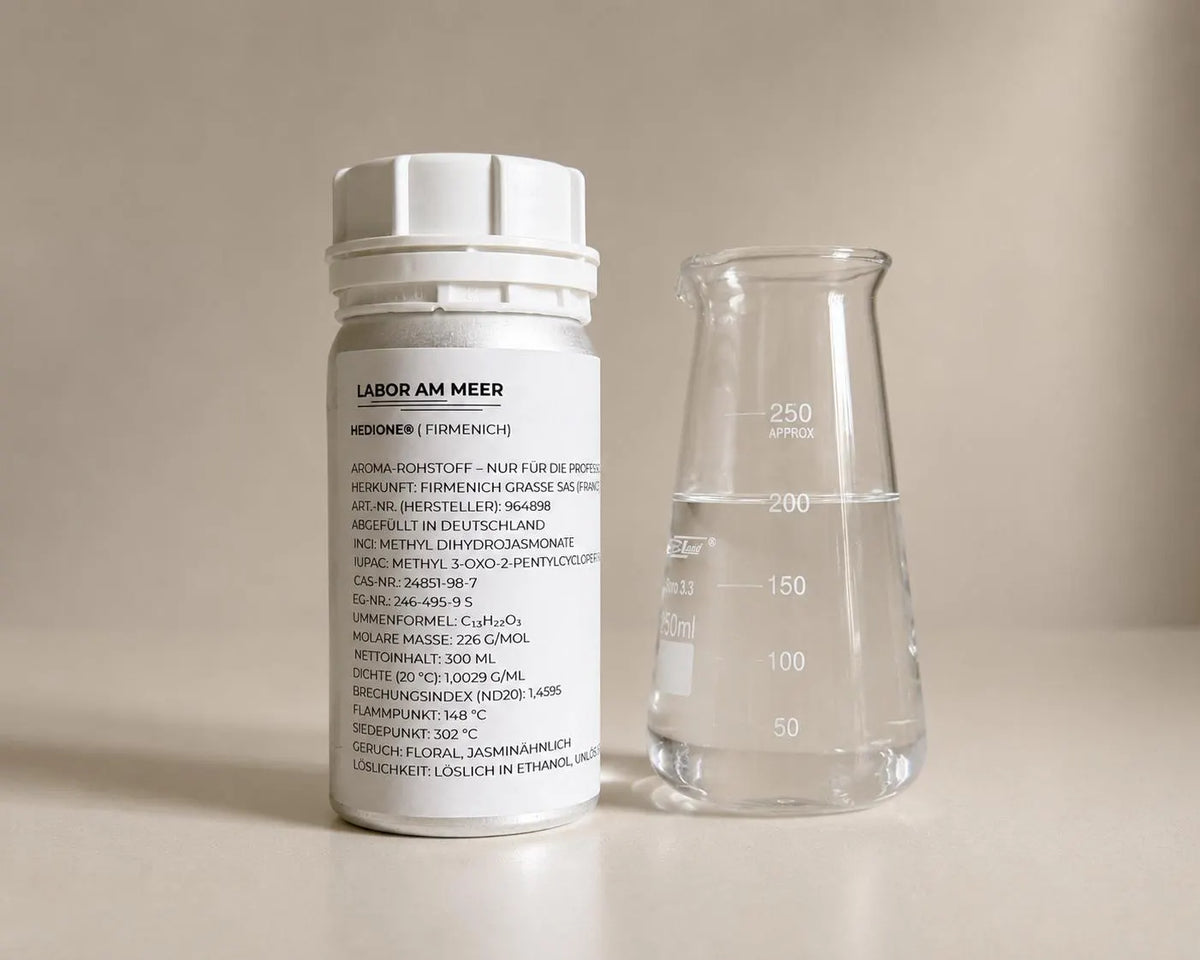
Hedione® – Methyl Dihydrojasmonate (Firmenich) | Perfumery Raw Material
Hedione® – Methyl Dihydrojasmonate (Firmenich) | Perfumery Raw Material
Couldn't load pickup availability
Hedione® – dsm-firmenich
Hedione is probably the most important molecule most people have never heard of. Since 1966 – the year of Dior's Eau Sauvage – it has been present in a large share of all fine fragrances released since.
Odor character
- Floral, jasmine-like, with a refreshing citrus touch (official technical descriptors)
- Elegant and transparent – a "white-flower" effect that lends compositions radiance and silkiness (manufacturer's description)
- Colorless to pale yellow, liquid
- Acts less as a single note, more as a structural element
Role in the formula
Hedione amplifies floral notes in perfume compositions and gives them presence, perceptibility and diffusion – without necessarily making the formula feel more intense. According to the manufacturer, it is classically used in jasmine and white-flower reconstructions and can also serve as a filler that harmoniously fills out a formula without introducing a dominant character of its own. It is used not only in jasmine accords but in practically every olfactive direction.
Historically, Hedione is regarded as the molecule that entered fine fragrance in 1966 with Edmond Roudnitska's Eau Sauvage for Dior – since then it has been all but indispensable in a large share of the perfumes released.
Use in perfumery
The general usage range according to the manufacturer is 2–15%, with significantly higher concentrations common depending on the application. Hedione is suited to floral compositions, jasmine and white-flower accords, and as a transparent filler that lends a formula airiness and radiance.
Recommended dosage by application (manufacturer figures):
| Fine fragrance | 12–38% |
| Shampoo | 8–20% |
| Shower gel | 8–23% |
| Soap | 5–17% |
| Detergent | 3–13% |
| Fabric softener | 4–13% |
| APC (all-purpose cleaner) | 2–8% |
| Candles | 5–17% |
Higher-cis grade: For a version with a particularly high cis content (78–100%) and therefore maximum radiance and diffusion, we offer Methyl Dihydrojasmonate 80/20 (High-Cis).
Practical note: dissolving, storing, combining
Dissolving: Soluble in alcohol and common perfumery oils, not water-soluble (confirmed by the current safety data sheet).
Storing: Store cool, dry and protected from light, keep containers tightly closed. Always keep in original packaging.
Combining: A classic component of jasmine and white-flower accords, proven in combination with indole, benzyl acetate and linalool for realistic jasmine hearts.
Safety information
According to the current safety data sheet from Firmenich Grasse SAS (version 10.1, 19 Aug 2025), Hedione is not classified as hazardous under CLP Regulation (EC) No. 1272/2008 – no labeling required. According to the manufacturer, the substance poses no physical hazard, no health hazard and no environmental risk under normal conditions of use. Not a PBT or vPvB substance, not assessed as an endocrine disruptor (neither for human health nor for the environment).
Toxicological data from the safety data sheet: oral LD50 (rat) >5,000 mg/kg, dermal LD50 (rabbit) >5,000 mg/kg. The Ames test for mutagenicity was negative. The flash point is 148 °C, the auto-ignition temperature 259 °C – not flammable in the sense of fire-safety regulations. For transport, Hedione is not classified as a dangerous good.
Ecotoxicological data: LC50 (fish, Oryzias latipes, 96 h) = 19 mg/L, EC50 (daphnia, 48 h) = 8.25 mg/L, ErC50 (algae, 72 h) = 45.9 mg/L. The substance is readily biodegradable. In Germany, water hazard class 2 applies.
Physico-chemical properties
| Manufacturer | Firmenich Grasse SAS (dsm-firmenich) |
| Chemical name | Methyl dihydrojasmonate |
| Product code | W08030 |
| CAS no. | 24851-98-7 |
| EC no. | 246-495-9 |
| FEMA no. | 3408 |
| REACH registration number | 01-2119493355-31 |
| Molecular weight | 226 g/mol |
| Appearance | Low-viscosity liquid |
| Melting point | <20 °C (OECD 102) |
| Boiling point | 302.2 °C (OECD 103) |
| LogP (log Kow) | 2.93 |
| Water solubility | Insoluble |
| Flash point | 148 °C |
| Auto-ignition temperature | 259 °C |
| Ecological profile | Readily biodegradable |
FAQ
What is Hedione?
Hedione (methyl dihydrojasmonate) is a molecule developed by dsm-firmenich (formerly Firmenich) in the 1950s/60s with a transparent, jasmine-like odor character. It became world-famous in 1966 through Edmond Roudnitska's Eau Sauvage for Dior.
What dosage should be used?
The general usage range is 2–15%. Depending on the application, however, significantly higher concentrations are common – for example 12–38% in fine fragrance.
What is Hedione typically used for?
For floral compositions, jasmine and white-flower reconstructions, and as a transparent filler that lends a formula radiance. It is used in practically every olfactive direction, not only in jasmine accords.
Is Hedione classified as hazardous?
No. According to Firmenich's current safety data sheet (version 10.1, 2025), Hedione is not classified as hazardous under the CLP Regulation – no labeling required.
Hazard Information (CLP Labelling)
Not classified as hazardous under Regulation (EC) No 1272/2008 (CLP), as amended. No hazard pictogram, signal word or hazard statements (H phrases) required.
Substance: Hedione® / methyl dihydrojasmonate (CAS 24851-98-7). The legally binding labelling appears on the packaging.
Important note
This product is a perfumery raw material intended exclusively for fragrance development, creative experimentation, education and the study of perfumery materials. It is not a finished cosmetic product. Please use responsibly.
Share